From Problem to Practice
3 Session Activities that create a problem for players to solve, not actions to be performed

I recently shared a post exploring what happens when we design sessions as problems to be solved rather than actions to be performed(Do We Coach ‘Actions to be Performed,’ or ‘Problems to be Solved?’ ).
I examined how, with a problem-solving lens, we open the door for new ways to explore player actions, individually and collectively, instead of a more rigid, prescribed ‘actions to be performed.’ I highlighted an activity - ‘Too Much Pressure’ an activity designed to challenge players to handle increasing levels of defensive pressure.
Today, here are three more activities that fit the bill as problems to be solved as opposed to actions to be performed.
1 - Offset Off Balance: “How do we navigate a situation where we must defend one channel, but attack another?”
In “Offset Off Balance,” teams can only score from a specific channel, but must defend the other channel. This forces players to manage compactness, pressure, and transition, and so they must solve where, when, and how to defend and attack.
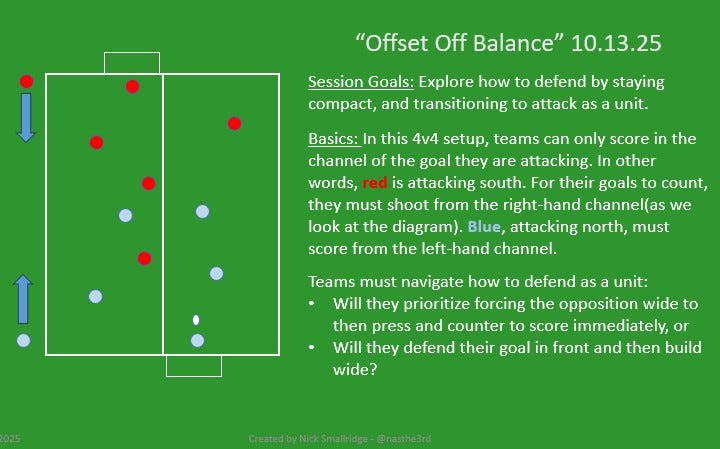
In the following clip, I show how I set up the problem for our Bentonville High School players:
I try to keep my instructions simple, with as little explanation or “Here is how you should do it” from the start. In other words, as little as possible, as much as necessary. I try to keep it under a minute, and then I step back. How will they self-organize, and how quickly can they start solving the problem?
Quick note: This session activity has been used for older age groups(U16-U19), but I would also be happy to use this for my U10s as well. Adjust size of pitch as needed.
2 - Breakout! - Wide Areas: “How do we defend wide areas from counter-attacks?”
In “Breakout - Wide Areas,” we use a breakout box to set the problem of ‘How to defend wide areas from counter attacks?’ The yellow midfielder with the ball dribbles into the breakout box and keep possession for ten seconds. If he loses possession(which he likely will), but blue team breaks out and attacks. The rest of the players are set up as shown to encourage blue to use their wide defender to counter. How will yellow defend?
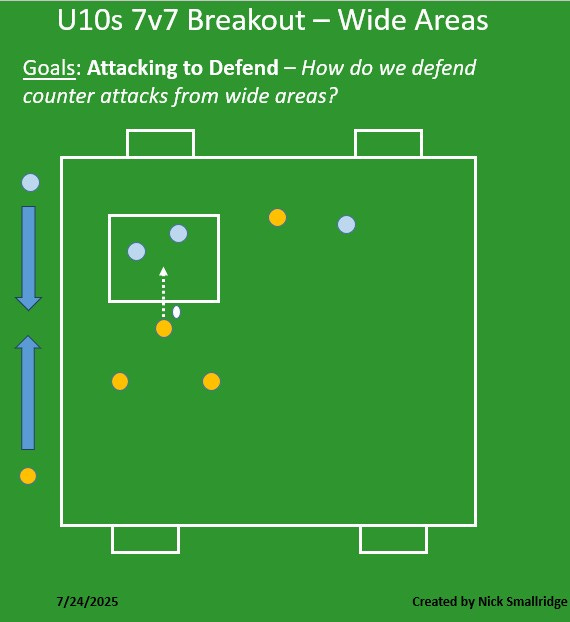
Quick note: Breakout boxes are fantastic to set up transition problems for a variety of in game situations for players. Highly recommend for U10s up through U19.
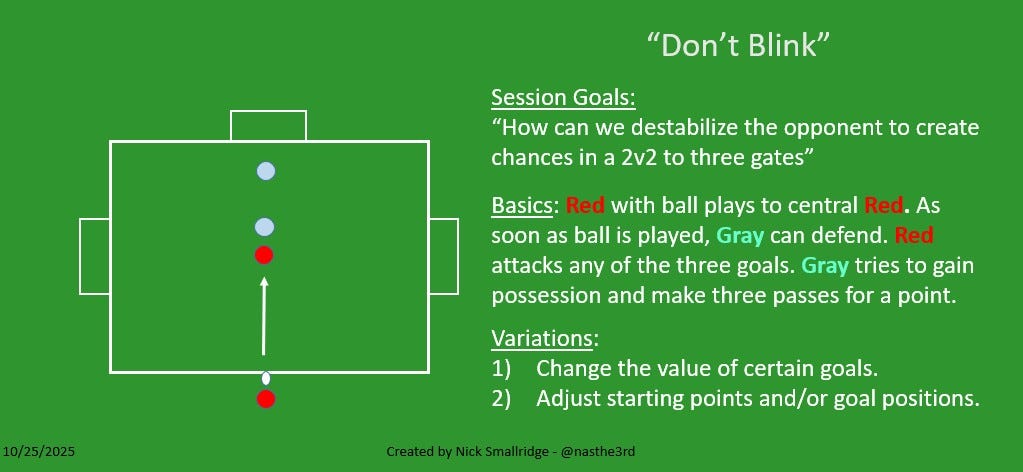
3 - Don’t Blink! - “How can we destabilize the opponent to create chances in a 2v2 to three gates?”
A super simple set-up that I like to use as an activation for both U10s as well as U16-U19s, in “Don’t Blink,” the team in possession has more goals to attack than defenders available. This overload of opportunities creates a situation where players have a huge incentive to manipulate the opponent. What different ways can we get them going one way to then go another?
Quick note: All of the above activities I have used in sessions with players at least once, and will use again.
Do you have sessions or session activities that have created problems for players to explore? Share below!
For Further Reading:
Who Do We Coach When the Ball is At Their Feet?
Beyond “Pass it!” A Framework for Coaching Language
In the Tension Lies the Talent
There is no Attack, There is No Defense: Rethinking Principles of Play
Hah! First time I understood the games as presented. Fine work.