Coaching the Overlap
A Practical Guide to Creating Overloads with U10s

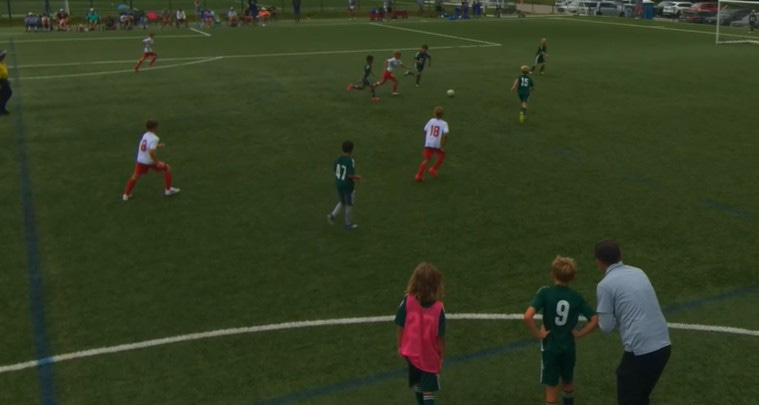
Overlaps are one of the most common combination attacking movements young players can explore, and can serve as a basis for learning how to create overloads in dynamic, relational ways. They blend timing, deception, spacing, and teamwork. But too often, they’re taught as unopposed fixed patterns or drills: “the 2 always overlaps the 7 with a run around the outside.” The danger in that approach? Players learn the what, but not necessarily the when, where, or why?
What we want instead is for players to recognize overlaps as a tool for creating overloads generally, to understand contextually when it’s on, how to organize, and how to make it destabilize the opposition with representational space, opposition, and teammates.
Context
This 3-week progression was part of our twice-a-week training rhythm, structured within a Play-Practice-Play model. The sequence began in Week 3 of our season, after we’d already established core routines and expectations. That foundation allowed us to zoom in on one central idea- using overlaps to create overloads- while keeping sessions dynamic, exploratory, and game-realistic.
Each week, we used a single focused activity within the “Practice” phase to explore how overlaps could help players connect, combine, and create. The goal wasn’t just technical execution. It was technical outcomes based on perceptual attunement: helping players learn to read the defender, attune to the moment, and adapt their movement accordingly.
Session Focus: Attacking in the Attacking half
Principle: Creating Overloads through Overlaps
Key Question: How can we work together to create advantage and create chances?
Week 3 Day 1
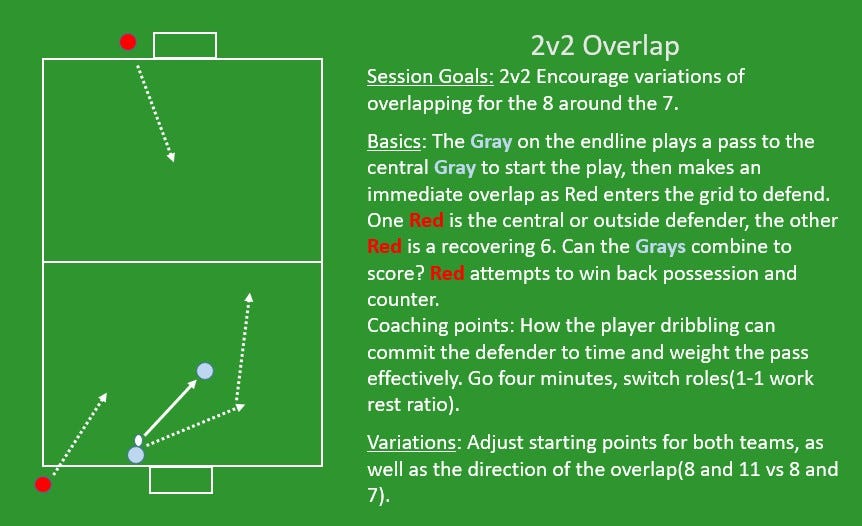
Activity: 2v2 Overlap
Goal: Introduce the basic overlap as a method for combination play
Setup:
Grid split into two halves. One attacker starts centrally with the ball (Gray), another slightly wider. Central attacker plays the ball to teammate and overlaps.
Defenders (Red) enter from the side as soon as the first pass is made.
Key Constraints:
Opposition: Defenders are live immediately. How can the attacker play the ball with functional weight, angle, and timing?
Spacing: Attackers are situated against the touchline. Can we navigate a combination in task relevant space?
Attack/Defend: If the defenders win the ball they can counter. Failure is a possibility, are we prepared to transition to defense if we are unsuccessful?
Coaching Focus:
Do we use the overlap? Or does the player in possession keep the ball?
Can the dribbler commit the defender to free the overlapping runner?
Are players sensing whether the overlap will create or close space?
Variations:
Vary direction of overlap (inside vs outside)
Vary the run of the playing in possession. After receiving the initial pass, what happens if the player on the ball dribbles straight? Diagonally inside? Diagonally wide? How does that change the options to attack?
Defender roles: central defender + recovering 6- adjust defenders starting positions.
Explanation
This activity provided a structure, but didn’t dictate the solution. It gave players a rhythm to explore, not a rigid pattern to repeat.
Week 4 Day 1
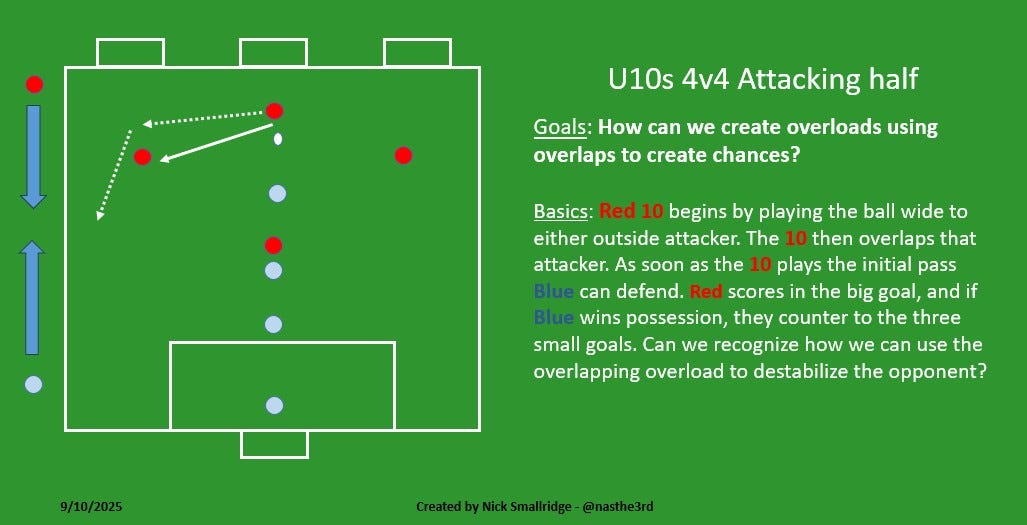
Activity: 4v4 Attacking Half Overlap Trigger
Goal: Scale the overlap to involve more teammates and defenders
Setup
4 attackers vs 4 defenders in the attacking half. Red attacks large goal; Blue counters to 3 small goals. Red 10 initiates play by passing to one of the wide players, then overlaps. Defenders (Blue) go live after the first pass, and if they win possession, they counter to the three small goals at the halfway line.
Key Constraints
Same as last week, but with larger numbers.
Opposition: Defenders are live immediately.
Spacing: Attackers are situated against the touchline.
Attack/Defend: If the defenders win the ball they can counter.
Coaching Focus:
Are players recognizing how to destabilize or isolate defenders?
Is the overlap pulling a defender or creating indecision?
Are attackers adapting based on defender pressure?
Explanation
Attack starts with an overlapping action, but what happens next is up to the players. The overlap becomes less of a “move” and more of a moment. Players began to anticipate what their movement might invite the defender to do, and how that creates new options.
Week 5 – Day 1
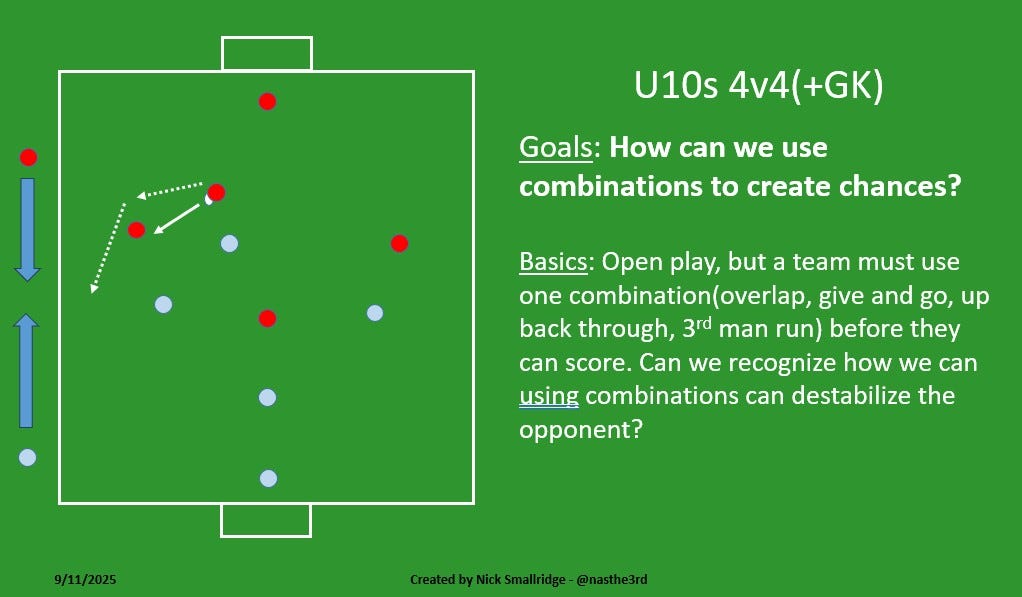
Activity: Open 4v4 with Combination Constraint
Goal: Transfer overlap concepts into open play
Setup
4v4 in a free play zone
Key Constraint
There’s only one: a combination move (overlap, give-and-go, 3rd man run, up-back-through) must occur before a shot.
Coaching Focus
Can players choose when to use overlaps based on context?
Are combinations emerging naturally, or being forced?
How are players reading teammates’ and defenders’ movements?
Explanation
By now, the functional fit of overlaps has been embedded. Now, with open play, players can explore when and where to use that combination to destabilize the opposition and exploit the overload created, or the misdirection of the overlapping runner.
Overall Rationale
The goal wasn’t to teach a tactic. It was to open a door to recognizing how movement creates advantages. Overlaps in context are great entry-way points to coach combinations because they:
Invite deception
Attune both attackers’ and defenders’ attention to relevant cues in the environment
Create temporary overloads with the risk of failure and the reward of success
Offer layers of choice- when, where, how else?
Why Once Every Three Weeks? The Power of Spacing and Interleaving
Rather than treating the overlap as a one-off session theme, we spread it over three weeks to take advantage of spacing effects and interleaving.
Spacing effect: By returning to the concept each week, with time and other topics in between, players had to re-engage with that movement in context each time. ”Individuals in spaced practice conditions outperformed those in massed practice conditions by almost one half of a standard deviation”(Donovan and Radosevich, 1999). This strengthens adaptability, pattern recognition, and transfer.
Interleaving effect: Because we didn’t isolate overlaps from other content (the sessions were nested in a broader Play-Practice-Play structure with varied principles, constraints, and focus points), players learned to recognize overlaps in context, not in isolation. They began seeing overlaps as one option among many, and they also began understanding how to defend against them. By maintaining fidelity of attack and defense, by layering different session topics and focuses between, players were able to explore, stabilize, and exploit ways to use it against defenders. Defenders, subsequently, were challenged to explore ways to protect against it(maintaining numbers behind the ball, delaying, tracking the runner).
In short, giving players room to breathe allowed movement off the ball to become part of the player’s sense-making repertoire, not just a one-off technique on command.
This approach mirrors how we want players to perform: not on autopilot, but through informed adaptation.
For more on:
Coaching Language- How we can move from Commands to Constraints
Rethinking Principles of Play: Destabilize
Eat Your O.A.T.S - A four week progression for Over, Around, and Through
Technique is not the Starting Point: It’s the Outcome
Defensive Pair Play: Surf & Slide Rush Defense, by Greg Revak. I was thrilled to get to spend some time discussing coaching language, skill, and emergent play with Greg recently on his Hockey IQ Podcast
Source:
Donovan, J. J., & Radosevich, D. J. (1999). A meta-analytic review of the distribution of practice effect: Now you see it, now you don't. Journal of Applied Psychology, 84(5), 795–805.