Shaping Intentional Session Blocks
How our words can turn training themes into shared stories


Recently, Coach Luca and I were discussing training blocks, and how we organize player development topics across a season. Club or FA models might frame a 6 week programme block around a topic such as Pressure Cover Balance, before shifting to a different topic.
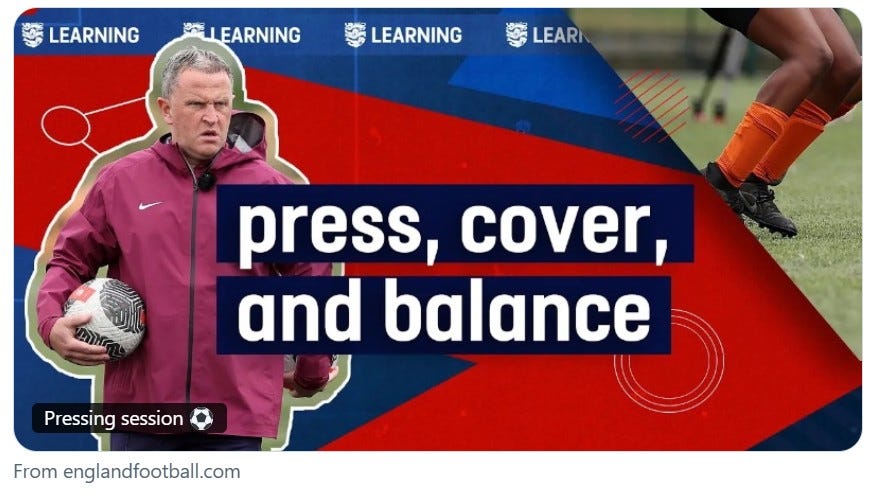
These kinds of topics are useful for coaches and clubs. They build shared understandings of intention, player development, and team cohesion across levels. But is this language what works best for players?
How we frame our sessions and session blocks for each other as coaches, vs how we communicate that to players, can matter as much as the session structure itself.
From Topics to Intentions
I’ve been coaching a 2016 boys team where the club’s 7v7 seasonal plan follows a classic rhythm:
Week 1 Day 1: Front Half Defending
Week 1 Day 2: Back Half Defending
Week 2 Day 1: Back Half Attacking
Week 2 Day 2: Front Half Attacking
There’s an understandable and cohesive pattern to the sessions, with coverage, variety, and progression. But there’s also a problem: no nine-year-old lights up when they hear, “Today we’re working on front-half defending!”
So instead of naming the block by topic, what if we named it by intention?
The first two weeks become HUNTING.
The next two, PROTECTING.
Suddenly the theme means something to a 9 year old. The sessions no longer feel disconnected; they become like chapters in a story. How can we be hunters when we have the ball? When we don’t? How can we protect the space, or the ball, or each other? “Front Half Defending” becomes “Can we hunt for the ball and win it as quickly as we can? How could we do that?” Exactly the same structure but with a different story, framing who we are with what we do more intentionally, and also getting overall better engagement. (For more on Practice as Problem Solving)
Language as a Constraint
In an ecological sense, language is a constraint. It channels perception and shapes attention. Say “hunt,” and players immediately orient to cues of deception, pressure, and pursuit. Say “protect,” and they attune to cues of balance, cover, and support.
Each word creates intention and guides attention, a way of seeing and feeling the game holistically that resonates with players. Just like pitch size, rules, or task goals, our words set boundaries and shape possibilities. They encourage which affordances players notice and which they ignore.
We often think of constraints as rules, cones, and conditions. But language is often the invisible constraint, and it has the power to color the whole environment with the message it sends.
Subsuming for Coherence and Engagement
From a learning standpoint, unifying four sessions under one holistic term like HUNTING also aligns with David Ausubel’s idea of subsumption. Ausubel proposed that new ideas are learned meaningfully when they connect to a larger, more inclusive concept that learners already understand.
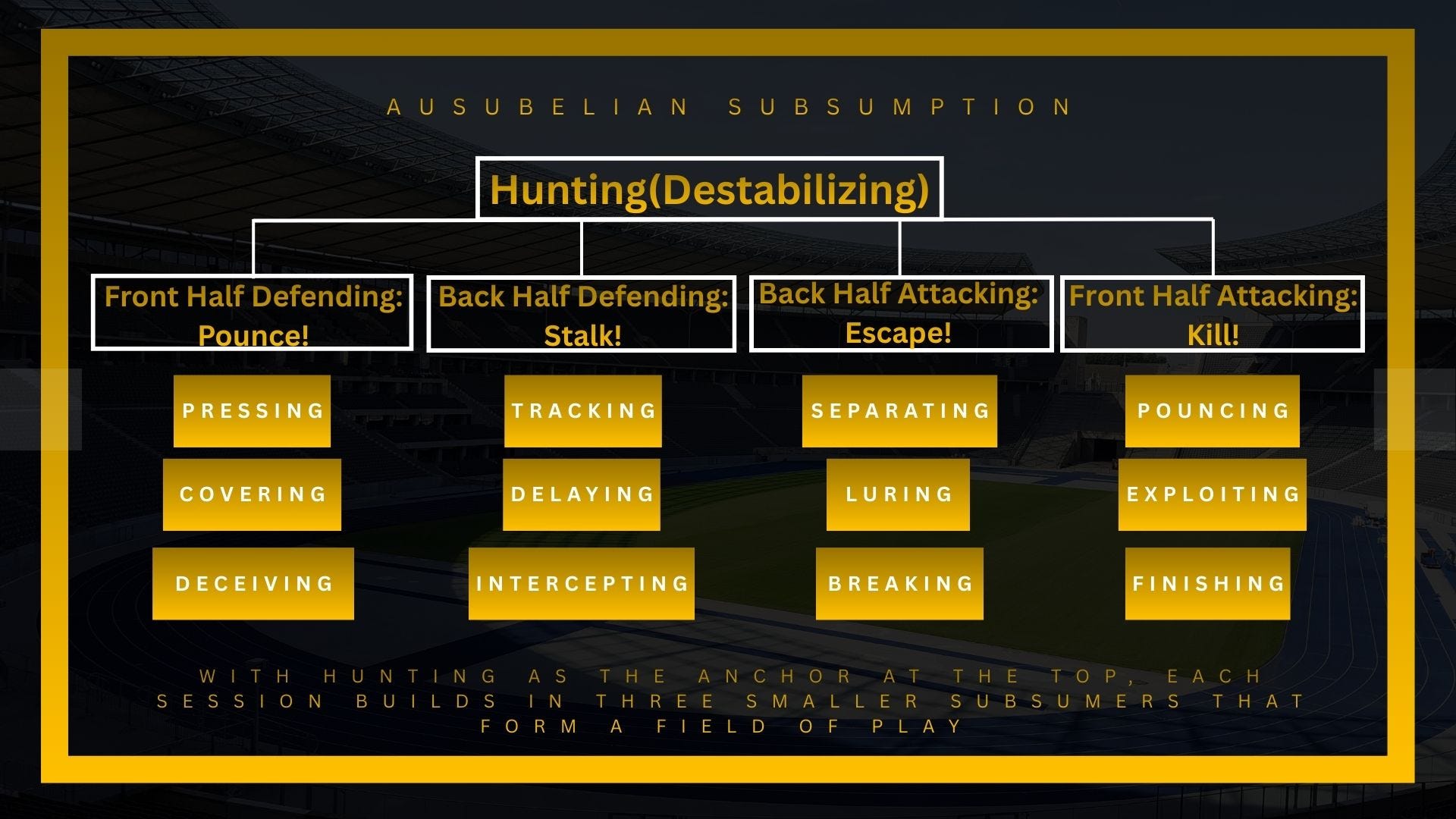
When a block is framed around a single holistic concept, it becomes the organizing anchor, a conceptual ‘subsumer’ that gives context and meaning to each session. Every new task or question (“How can we hunt when we have the ball?” … “How can we hunt without it?”) attaches and subsumes(builds) into that existing larger frame, rather than sitting as an isolated experience.
In this way, the term HUNTING can unify playing experiences into memory in a meaningful way. The repeated interactions over the two-week block build relational links between ideas, experiences, and emotions, allowing players to retain and transfer understanding more effectively. The theme becomes both the lens and the scaffold for learning.
From Individual Cues to Collective Intention
A lot of my writing on language has been focused at the micro level- the individual coach’s cue. Commands, Situationally Convergent Questions, Divergent Questions:
“Squeeze!” (Command)
“Where can we move to support?” (Situationally Convergent Question)
“What are our options?” (Divergent Question)
Those cues, phrases, and questions guide perception within moments. (For more on question types —> Beyond “Pass it!” A Framework for Coaching Language)
But at the macro level- the design of the block itself- language can unify an entire phase of learning. When every practice, cue, and question falls under the same banner- HUNTING or PROTECTING- players begin to live inside that world. It becomes a shared story of intention that links everything together. You don’t need to remind them what the focus is. They feel it.
Interaction-Based Principles: Destabilizing and Stabilizing
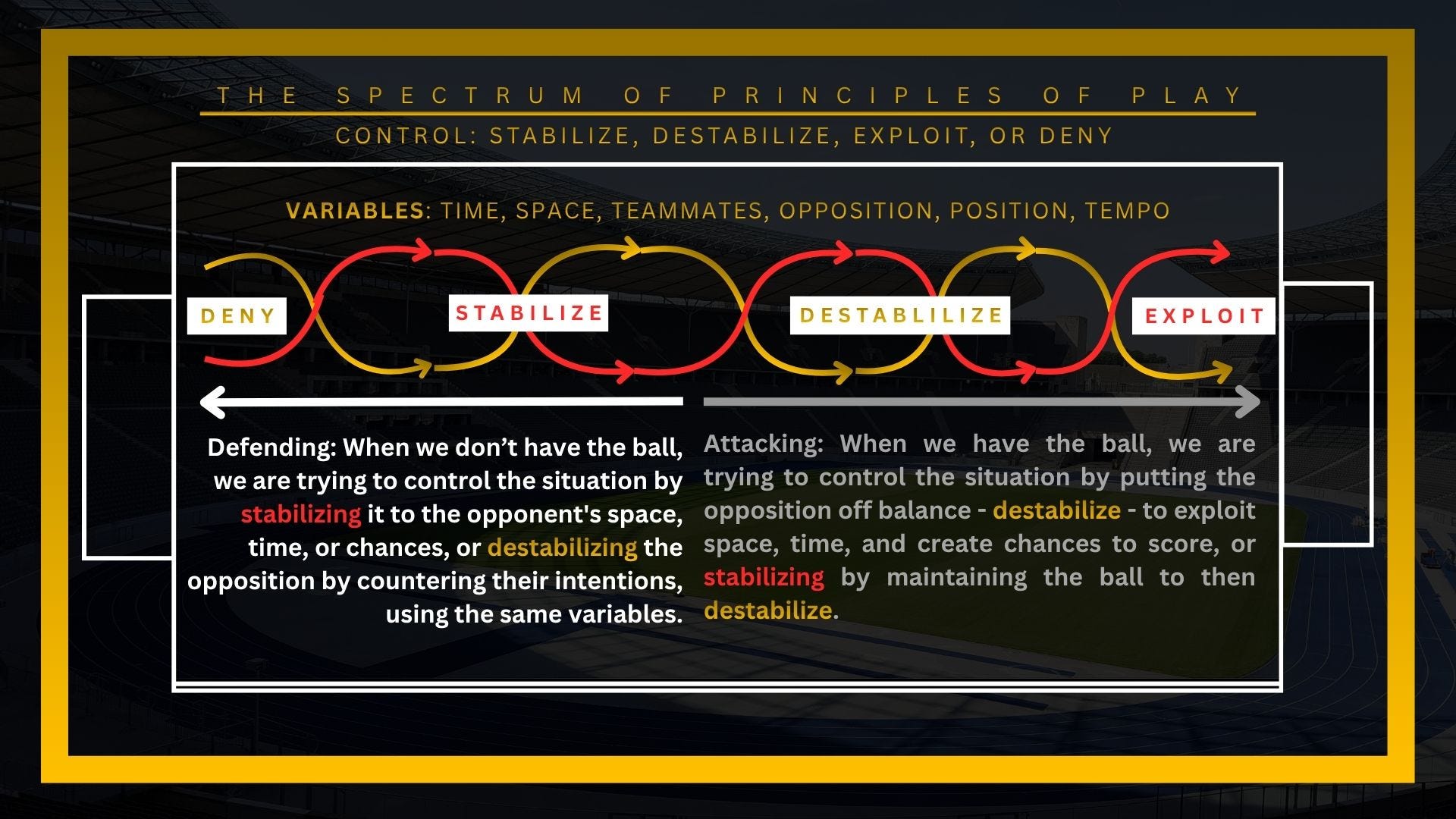
The beauty of these kinds of themes is that they also align directly with interaction-based principles. Each carries its own dynamic:
HUNTING → Destabilizing the opponent’s system (pressing, countering, advancing, exploiting).
PROTECTING → Stabilizing our own system (retaining, delaying, recovering, denying).
Across the season, you can cycle between these intentions, not as disjointed topics, but as rhythmic opposites. Destabilize, then stabilize. Stretch, then settle. Hunt, then protect.
The game breathes that way, so why can’t our design?
From Coach Luca
With my U8s, I ran a session a few weeks back on defending as a team which we labelled “hunting as a pack” and we brought this to life even more by connecting the idea to wolves hunting as a pack. As soon as we introduced the topic the group broke out into wolf howls. The engagement was there immediately, like a flick of a switch. [Designing sessions in this way] moves me as coach from narrator to joint storyteller (with the players). Together we can come up with the characters, describe how they act, set the scene and play it out.
We can ask how they want their wolf to act? What happens when they act that way? Patient or impatient? Stalk or pounce? A lone wolf or wolves working together as a pack? What does that look and feel like? (For more on who we coach- Who do we Coach When the Ball is at Their Feet?)
We don’t even necessarily need to cue them the whole time because they can tap into their own imaginations and their pre-existing ideas - how a wolf prowls, stalks, pounces (or how one sounds!). The idea can communicate in tandem with our words. Get too abstract though and we may lose them, but get the balance right and it could be magic. To do this we need to know our group and what language or ideas will speak to them best.
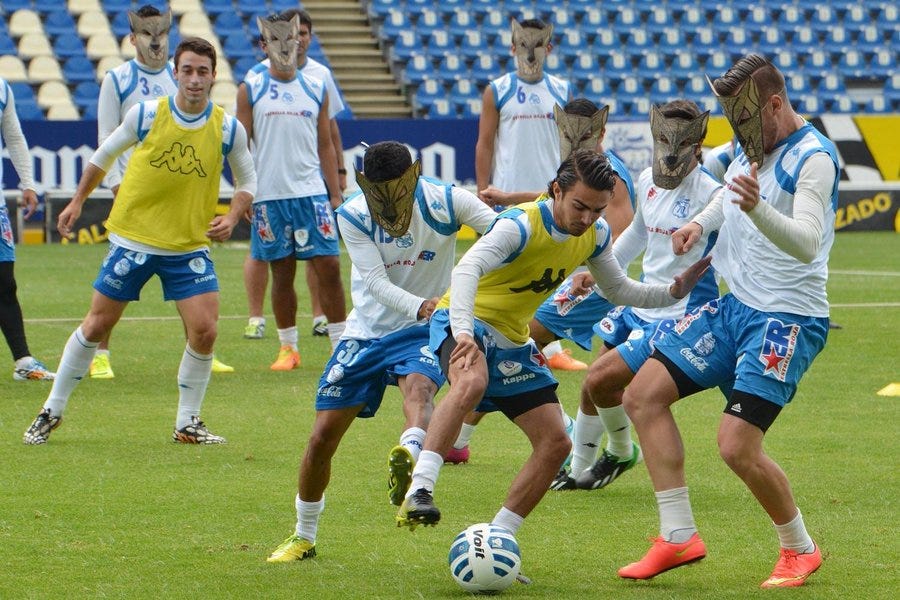
This isn’t only for foundation phase players either. Puebla’s Jose Sanchez Sola copied an idea from Diego Simeone’s Atletico Madrid, and trained with wolf masks to elicit the feeling of hunting as a pack...
Topics to Tensions
So maybe the real shift isn’t from “random” to “block,” or even from “topics” to “themes.”
It’s from topics to tensions, from naming what we’re doing to exploring how it feels to play inside it. Language makes that possible. The words we choose don’t just describe or decorate our session plans; they are designed to shape the affordances our players perceive, the actions they attempt, and the intentions they share.
Because in the end, language doesn’t just describe the game, it can help design it. Maybe the better question isn’t “What are we training this week?” but “What story are we inviting our players to live?”
For Further Reading:
Who Do We Coach When the Ball is At Their Feet?
Beyond “Pass it!” A Framework for Coaching Language
In the Tension Lies the Talent
There is no Attack, There is No Defense: Rethinking Principles of Play
Technique is Not the Starting Point - It’s the Outcome
Feedback, Skill, and Dynamic Systems
Sources:
Cotteringham, S. (2023). Ausubel’s Meaningful Learning in Action. John Catt Educational Ltd.